Portfolio Update: 3 June 2026
This post documents the past month of work across my portfolio. It is not content for its own sake, but a record of what is actually happening, offered to those supporting or following this inquiry. I welcome corrections, additions, and disagreements from anyone working in this space.
Evolving Kent County Council's Climate Adaptation Plan
The primary thread of this period is a critical analysis of Kent County Council's Climate Change Adaptation Plan 2025-2028, developed in response to an invitation from a member of KCC's Energy and Adaptation Team to review the plan and propose improvements.
The analysis draws on the framework of civilizational optionality developed by Indy Johar, Robyn Bennett, and Malik Lakoubay at Dark Matter Labs. The core argument is that KCC's approach applies fortress logic to a field-scale problem. Fortress logic secures bounded agency for a specific institution within a narrowing range of options. Field logic regenerates the ecological, economic, social, and institutional conditions from which any durable institutional position must emerge. In an age of degenerative volatility, the two are not interchangeable.
Degenerative volatility is distinct from episodic crisis. When you fall ill repeatedly without full recovery, your baseline drops. Each subsequent shock finds you more vulnerable than the last, not because the shocks are escalating, but because the conditions that once absorbed them are themselves deteriorating. This dynamic is now operating across ecological, economic, social, and institutional domains simultaneously. Water systems in Kent and across the southeast are under compounding abstraction pressure. Britain's food supply faces structural risks that cross county lines and administrative boundaries. Insurance markets are already beginning their retreat from exposed geographies. These are not isolated problems. They are cascades.
KCC's plan is not the problem. It is professionally competent, evidence-led, and unusually candid about its financing limits. The critique is of the approach, not the effort. The plan's risk formula treats climate impacts as external shocks on a stable system. It does not account for cascading endogenous reconfigurations, the kind where a heatwave simultaneously loads energy, health, roads, and food systems, and each subsequent shock finds those systems less capable of absorbing it. Insurance withdrawal cascades into property collapse, which erodes the tax base, which constrains the council precisely when capacity is most needed. This dynamic is not captured by KCC's existing risk calculations.
The financing logic follows the same pattern. KCC's own plan acknowledges that current budgets are "highly unlikely" to fund the measures the challenge requires. Yet the financial strategy remains organized around avoided cost on KCC's balance sheet, securing institutional position within a narrowing landscape rather than regenerating the conditions from which that position emerges. The shift required is from spend-to-avoid to value-of-continuity by quantifying the cascading losses to Kent's foundational economy that adaptation prevents, including the agricultural output preserved, the insurance claims avoided, and the social care demand not generated. These are the numbers that attract continuity capital.
The recommendations span three registers. The first, achievable within the plan's existing mandate, involves replacing a fortress-logic risk equation with a baseline conditions framework that monitors aquifer recharge, soil health, ecosystem connectivity, and social cohesion proxies alongside service-level metrics, and redesigning monitoring around optionality rather than delivery counts, tracking whether each action expands or narrows future pathways.
The second builds the intelligence and civic infrastructure beyond the institutional perimeter, including a Wealden Bioregional Observatory for shared anticipatory sensing, a foundational economy audit, an insurance market dialogue, and bioregional risk clinics across various Kent contexts.
The third, and most consequential, involves structural advocacy and institutional design by repositioning Kent's adaptation work as an investment opportunity for continuity capital, advocating through the Local Government Association for a Local Government Continuity Finance Mandate, and establishing a Wealden Bioregional Financing Facility as an independent commons institution governed by ecological, agricultural, community, business, and public sector actors with 20-30 year adaptive investment commitments.
The keystone move is the financing facility. No single actor currently holds what that institution would need to hold, on the time horizons that matter.
The political reality derailed any formal collaboration. However, this outcome does not make the recommendations inactionable. Most of what matters in the three-register roadmap does not require KCC authorization. A bioregional financing facility is a commons institution, not a council program. A foundational economy audit is a research and convening task. A bioregional observatory is a shared intelligence infrastructure. All of these are possible to initiate through alternative channels, and KCC staff who are aligned with the direction remain able to contribute in their personal capacity.
Emerging Connections Across the Valley
The second thread is more distributed, but no less substantive.
Social media outreach across Darent Valley and Sevenoaks forums over the past month produced high engagement and responsiveness. Artists, campaigners, ecologists, and community organisers oriented around the river valley and the wider local area are reaching out to get involved.
Several collaborations are emerging from these meetings, two of which are worth highlighting.
Theo Silberston and Phelim McDermott approach the same problem from different angles, and together they bring a compelling set of capacities to collective visioning in Sevenoaks. Theo’s social enterprise, Shared Horizon, works to close the imagination gap by creating cultural conditions for people to think differently about the future, collecting data on how people imagine when properly supported, and connecting those visions to real action. Devoted and Disgruntled, the Open Space process Phelim has run since 2005, works without a fixed agenda, on the principle that the people who show up are the right people and what emerges is what is ready to emerge. Applied to the local context, the question Theo and Phelim are now scoping together is how large-scale deliberative gatherings can surface what is latent, connect what is isolated, and create the conditions for collective action that no single actor could have designed in advance.
Additionally, local software engineer Mark Hopgood is adapting an existing chatbot platform to create a conversational tool specifically for the River Darent. The aim is to give community members a low-barrier way to explore river ecology and species interactions through an engaging, dialogic medium, meeting people where they already are rather than requiring them to seek out formal educational materials. A river that people can talk to, even in a limited technical sense, becomes more present in their daily lives. This presence matters because bioregional governance depends on people caring about the living systems around them, and caring depends on knowing them. Mark's tool is an infrastructure for this kind of knowing.
Learning and Development
Three competency investments during this period, grounding the portfolio work both in theory and in practice.
U-Lab via MIT's Presencing Institute: This course, developed by Otto Scharmer and the team behind Theory U, builds the capacity for systemic sensing, the ability to perceive the deeper forces shaping a situation before attempting to intervene in it. The practice distinguishes between downloading existing frameworks onto a problem and genuinely opening to what the situation itself is asking for. This distinction matters enormously in bioregional work, where the tendency to import models from elsewhere is a persistent failure mode. Completing U-Lab sharpened the sensing practices I bring to every thread in this portfolio.
Riverfly Monitoring Certification: Riverfly monitoring is a citizen science method for assessing the ecological health of chalk streams through the presence and abundance of indicator invertebrates. The Southeast Rivers Trust trains community members to conduct standardised counts at designated sites, feeding into a regional baseline dataset. Becoming certified grounds the abstract commitments of bioregional governance in something concrete, knowing what a healthy Darent looks and feels like at the water's edge. See upcoming events below if you are interested in attending the next session.
Regenerative Evaluation Community of Practice: One of the persistent challenges in regenerative and systems change work is demonstrating value in terms that funders and institutions recognise, without reducing that value to what is easily countable. The Regenerative Evaluation Community of Practice is developing frameworks for assessing systemic, relational, and ecological impact with more rigour and more honesty than conventional monitoring and evaluation allows. Joining this community is a direct investment in the capacity to show, not just assert, that transformation is actualizing.
An Invitation to Collaborate
If you live in Sevenoaks or the wider Darent Valley and are interested in community land acquisition, please join me in Hastings for Hosting the Commons from 2-3 July 2026.
Hastings Commons is one of the most developed examples of community-led regeneration in England. Operating in one of the most deprived neighbourhoods in the country, it has taken over 11 formerly derelict buildings into permanent community stewardship. It is proof that it is possible to regenerate a place by putting land into community hands, and that the result can genuinely serve local people rather than eventually being captured by the market.
Hosting the Commons is a two-day gathering organised by Common Treasury, a new hosting centre within the Hastings Commons ecosystem. The programme includes stories from community builders across the UK, a workshop-tour of Hastings Commons, and practical steps for individual and collective action to create community land trusts. Flexible and subsidised ticketing is available for those who need it.
For anyone in the Darent Valley or Sevenoaks area who is curious about what community land stewardship could mean here, this is the place to learn the model from within its own ecosystem. It is also where the conversation about forming a local CLT stewarding group can begin in earnest. Message me after you secure a ticket if you want to attend as part of a Sevenoaks/Darent Valley cohort.
More Upcoming Events
Riverfly Monitoring Training at Bradbourne Lakes, Sevenoaks, 10 June 2026
A free training session from the Southeast Rivers Trust, open to anyone interested in learning the riverfly monitoring method at one of the Darent's most significant sites. No prior experience required. This is citizen science infrastructure for the chalk stream, and a direct entry point into the monitoring work that bioregional governance ultimately depends on.
FEST: State of the Field Gathering, 18 June 2026
Financial Ecosystems for Systemic Transformation (FEST) runs semi-annual gatherings to co-sense and describe the evolving landscape of financing systemic transformation. The next session takes place on 18 June from 15:00-17:00 BST. The purpose is to bring people in the field into better alignment through ongoing conversation about what practitioners are seeing, learning, and trying together, and to contribute to a balanced overview of ideas useful for field development. This is the financing conversation most relevant to the Wealden Bioregional Financing Facility as a proposal, and to the broader question of what continuity capital can look like at a bioregional scale. The apply-by date passed in May, but if you want to contribute asynchronously, do get in touch.
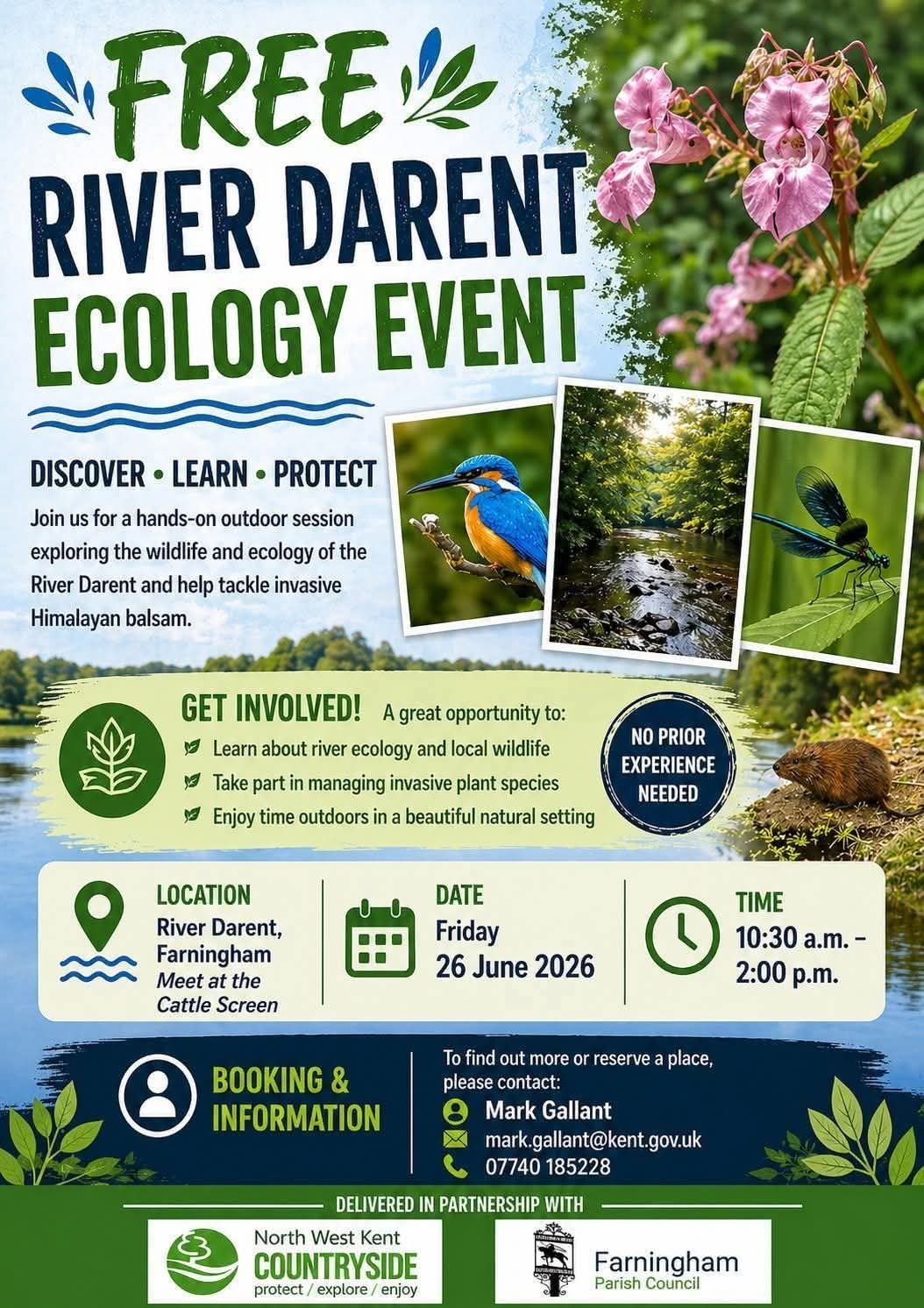
River Darent Ecology Event, Farningham, 26 June 2026
A free hands-on event exploring the ecology of the River Darent, run in partnership with North West Kent Countryside and Farningham Parish Council. See below for more details.
Citizen Infrastructure Builders Demo Days, late June onwards
A series of demo days beginning mid-to-late June, showcasing civic tools designed to empower community decision-making. Each session invites feedback from practitioners and community members on tools in active development. Relevant to anyone building or using civic infrastructure for participatory governance.
Chalk Streams and Rivers Festival, 25 August 2026
A grant application for the August festival was approved, providing £800 from Southeast Rivers Trust to match existing funding from the Shoreham Midsummer Festival. The event will take place at the Quadrangle in Shoreham, with Living Thames collaborating on programming. Planning is now in the logistics phase. More details to follow as the date approaches.
Support This Work
Much of what is documented here, including sensemaking, critique, convening, and relationship-building across scales, does not produce conventional deliverables. It produces the conditions under which genuine systems change becomes possible. This kind of connective work is difficult to fund through standard mechanisms, which is why portfolio patronage matters.
If this inquiry resonates and you want to sustain its continuity, you can subscribe to this monthly blog or make a one-time contribution. Both go directly toward maintaining the freedom of movement this work requires.
Please Note
I will be traveling from 11-24 June, with longer than usual response times to emails and messages during this period.
Updates are published monthly. The purpose is documentation, not content production. The work comes first.
If any of this intersects with your own professional or personal experience, connect with me via email or LinkedIn.