Portfolio Update: 06/08/2026
This post documents the past month of work across my portfolio. It is not content for its own sake, but a record of what is actually happening, offered to those supporting or following this inquiry. I welcome corrections, additions, and disagreements from anyone working in this space.
Repurposing a Regional Alliance into Bioregional Infrastructure
The South East Climate Alliance (SECA) covers Kent, Sussex, Surrey, and Hampshire, and has spent years running climate advocacy and lobbying across local councils and national government. Its leadership recently reached a crossroads. Local climate action networks now occupy much of the ground SECA once held alone at county level, and the organization has started asking what role remains for a body operating at that wider scale. The problem SECA now faces is really a question of scale. What work still needs doing across its four counties that no single-council network below it can perform?
A colleague invited me into this repurposing conversation, drawn in by a striking coincidence of geography. SECA's four-county footprint overlays the Wealden Dome almost exactly, the chalk anticline whose slow erosion carved the Weald and left behind the ringed springline that feeds the Darent and its neighboring chalk streams. My proposal, which several SECA members received with genuine enthusiasm, treats the transition as an opportunity. Instead of winding down, SECA could become a body that convenes and incubates bioregional hubs, including one for the Wealden Dome, lending its cross-boundary standing to a practice no single catchment or parish council could build alone. An alliance formed around one problem tends to expire once that problem migrates elsewhere. An alliance formed around a shared landscape does not.
This is not a proposal arriving from outside the alliance. Rob Simpson and I launched the Wealden Bioregional Learning Hub at SECA's own Annual Gathering on 28/03/2026, moderating a discussion table that introduced bioregioning to attendees encountering the concept for the first time. That the hub took root inside SECA's own conference, months before its leadership began questioning the alliance's future, suggests the reorientation now under discussion is less a pivot than a recognition of direction already set. The alignment runs both ways. SECA supplied the room and the audience the hub needed to launch, and the hub now offers SECA a concrete answer to the question of what comes next.
The SECA conversation stayed at the level of an organization and its convening role. Two other threads this month pushed the same question of scale down to something far more concrete, land itself, and who holds the right to speak for a river.
Contextual Differences for Community Land Trusts
On 2 and 3 July, I traveled to Hastings to learn from Hastings Commons, one of the clearest working examples of a community land trust in the UK. The organization has taken twelve buildings out of the speculative market and into community ownership, and its team was generous with the history of how the model took shape locally, along with the compromises that rarely survive into a tidy case study.
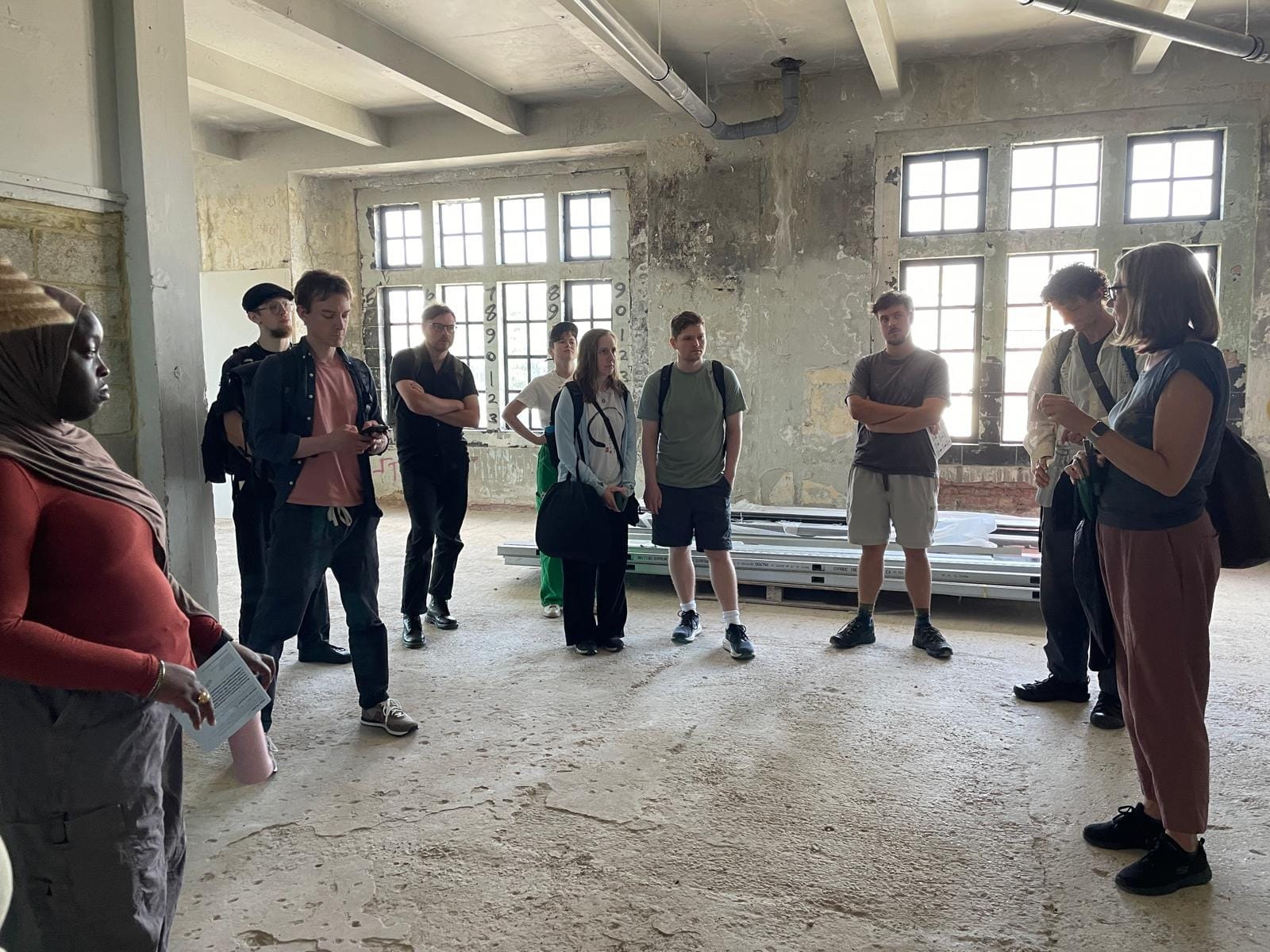
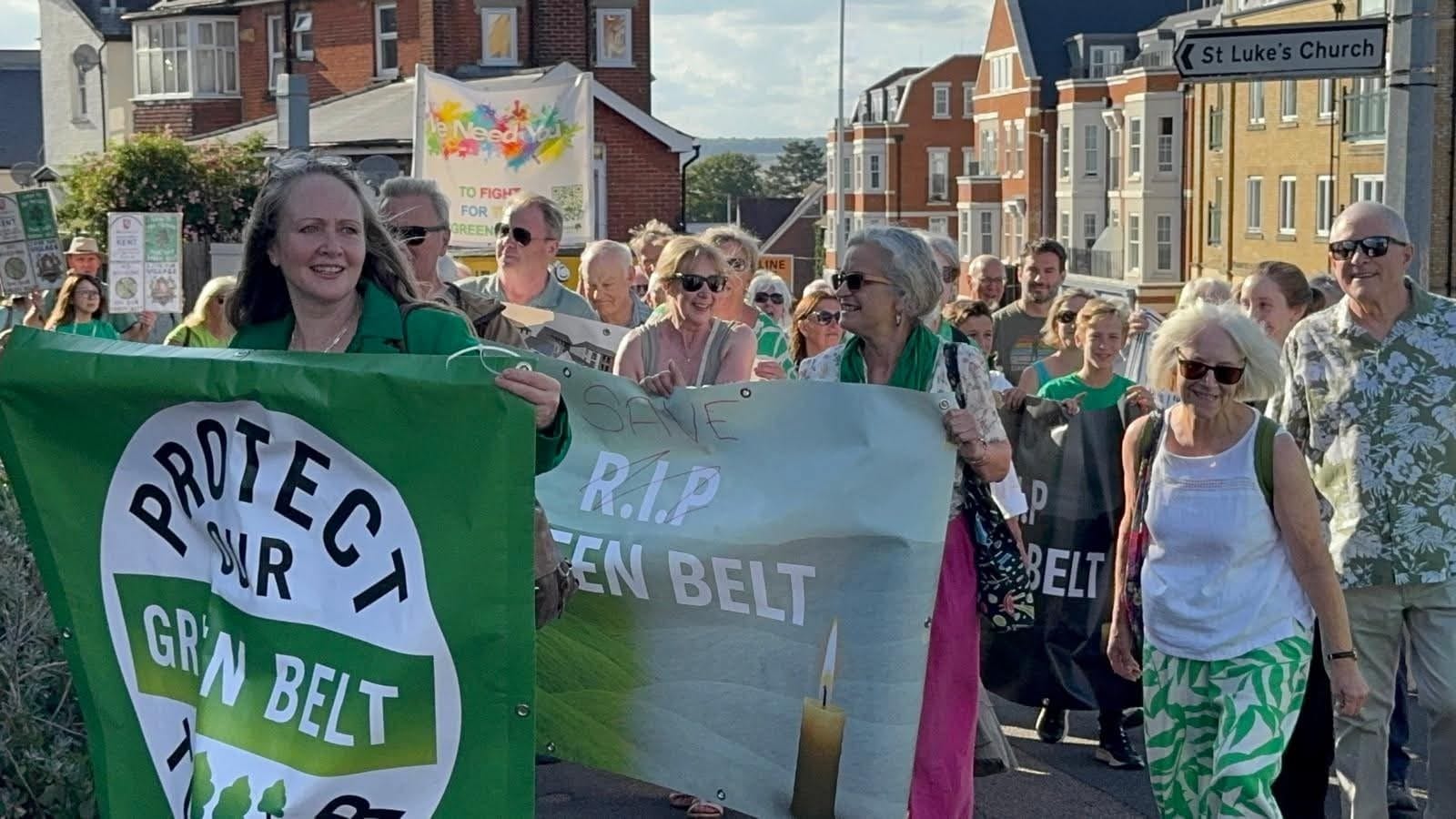
Hastings Commons operates at settlement scale, inside a dense urban area. Within the Sevenoaks context, could the same instrument hold agricultural and riparian land across an entire river catchment, rather than buildings confined to a town center? Put another way, if a community land trust is the right vehicle, at what scale should it actually hold land? This question sharpened considerably when I participated in protests which erupted across Sevenoaks in late June and early July against proposed Green Belt housing. Sevenoaks District Council's Local Plan, now at the Regulation 19 stage of consultation, must accommodate a national government-imposed housing target raised by 63% to 17,460 homes. Meeting that figure means releasing Green Belt land, including Pedham Place, a site that sits inside both the Green Belt and the Kent Downs National Landscape. Residents organizing under groups such as Protect Our Green Belt Together have raised water scarcity, drought, and strained infrastructure as reasons the district cannot absorb this growth safely.
A community land trust built at catchment scale, holding Darent Valley farmland and riparian corridor under ground leases that carry ecological covenants, offers a route that neither pure advocacy nor outright refusal can. It gives communities and rights of nature advocates a mechanism to remove land permanently from speculative pressure, regardless of what happens to administrative boundaries during local government reorganization. This is early, unincorporated thinking, not a committed plan, but it now sits alongside the objection work already underway on the Local Plan itself.
Tenure, though, only answers half the question. Holding land off the speculative market says nothing about what obligations that land carries toward the river running through it, which is another factor I spent considerable time sitting with.
Weaving Guardianship into the Wider Structure
I attended two different rights of rivers events in London and Aylesford, tracking the growing network of river guardians who take on formal or informal roles protecting catchment ecosystems and pressing for enforcement of rights that councils have acknowledged but rarely defined.
Sitting with this network alongside the Hastings and Green Belt conversations made the connections between their mechanisms impossible to miss. A guardian body has little to enforce without land it can attach consent rights to, and a council motion recognizing river rights has little force without a defined body prepared to exercise it. Guardianship needs tenure, and tenure needs guardianship, and neither resolves in isolation. The open question I am sitting with is not whether these functions belong together, but at what scale each one should sit. Does a guardian body answer to a single locality, an entire catchment, or something larger still? Three separate conversations this month, at three different scales, kept circling the identical unresolved question of who should hold which piece of the work, and where.
Developing a Matrix
Underlying all of the above is a continuing inquiry rather than a fixed design problem. At what scale should each function sit, and how does that answer change as I learn from the people already doing the work at each level? Tenure, guardianship, perpetuity, monitoring, learning, finance, and narrative do not all belong at the same scale, and I am not drafting a plan to hand down to catchment groups, guardians, or councils. I am building a strategic roadmap for my own engagement, one that tells me which conversations to prioritize and which questions to bring to whom, and that I expect to keep revising as sensemaking and feedback accumulate. Based on my knowledge of local context and existing stakeholders, I used an AI tool to produce a first draft of this roadmap, mapping candidate functions across six scales in a matrix, from a single site up through the Darent catchment, the Thames, and the Wealden Dome itself.
Three principles currently guide where each function tentatively lands, though these remain open to revision as the inquiry continues.
The first is that functions, as opposed to organizations, are the unit of design. The question is never who incorporates, but what work must happen and at what scale. A function can be performed by an existing body, a new one, or a loose group convened inside several bodies at once. Deciding who forms a legal entity comes last, and the honest answer is often nobody.
The second is a symbiosis test. A function belongs where its output feeds another function's input. Tenure that produces nothing for guardianship to attach to, or monitoring that produces nothing a financing facility can use, is either mis-scaled or unnecessary. Every function in the roadmap has to close a loop with at least one other.
The third is a rule of subsidiarity applied to duration as well as scale. Any body may permanently hold or perform a function that genuinely cannot be done smaller, but everything else it may only incubate, with a published sunset date and a named successor. This stops an endowed body with spare capacity from quietly absorbing work that a smaller, newer group would otherwise have grown to fill.
Two examples show this logic in practice. Community land trust tenure sits at town and catchment scale, not at the Dome, because holding land requires a defined community of place and a legal person accountable to it. A Dome-scale landowner spanning four counties would function as an absentee landlord regardless of its intentions. Covenant-holding runs the opposite direction. It belongs at Dome scale precisely because its only legitimate powers are negative, a veto and a covenant, never an operational mandate, and because monitoring a covenant in the year 2085 needs an endowment large enough to be credible, which no single catchment could raise alone. The same logic clarifies how guardianship and tenure relate. A river guardian can act without holding any land, through common law, litigation, and public pressure, as Paul Powlesland's work demonstrates. However, a consent clause written into a catchment-scale lease gives a guardian an obligation enforceable the moment the lease is signed instead of one that depends on a court's willingness to extend an existing doctrine. Tenure at catchment scale and perpetuity at Dome scale give guardianship a second, more immediate set of teeth alongside the ones that already exist.
None of this is settled, and it is not meant to be. I am seeking the advice of technical experts, systems change practitioners, and local community members for the disagreement and correction that only comes from people already working at each scale. Where their experience contradicts the current placement of a function, the roadmap changes. What stays constant is the discipline behind it, not any particular answer it currently holds.
Upcoming Events
Over the next few months, much of my time will be spent preparing for the following three events.
Chalk Rivers Festival, 25/08/2026, Shoreham: I am co-organizing this free event at the Quadrangle with my colleague Sarah Newman from the Shoreham Midsummer Festival, alongside Living Thames, the Darent River Preservation Society (DRiPS), South East Rivers Trust, the Darent Nature Partnership, the Darent Valley Farm Cluster, and Kent Wildlife Trust. The day runs in memory of Mark Lintell. In the afternoon, The Quadrangle hosts creative workshops including a print workshop using recycled tetrapak, a willow workshop for making river figures, a communal song session, a clay “Dream River” project, and a closed constellation session in which a small group listens for what the River Darent itself might need from its human community. In the evening, the Festival shifts into music, drinks, and speakers focused on the future of chalk rivers and the communities that care for them. Proceeds support DRiPS' restoration work on the Darent. Learn more and register here.
Sevenoaks Imagines test gathering, late September, Sevenoaks: I am organizing this alongside Theo Silberston of Shared Horizon and Phelim McDermott of Devoted and Disgruntled, whose collective imagination and open space work was discussed in a previous portfolio update. Together, we are preparing a small trial of thirty residents or fewer for a single half-day session to rehearse the Open Space format in a Sevenoaks context and seed topics for something larger. Timing waits on Phelim closing his run of Tao of Glass, his collaboration with Philip Glass now on stage in the West End through 12/09, which I saw recently and recommend without reservation. Lessons from this smaller trial will shape a full town-wide event planned for winter, likely spanning two days, open to any Sevenoaks resident willing to imagine a better future and help decide what to do about it.
Living Thames Bioregional Convergence, 16–17/10/2026, Pangbourne: As a core team member of Living Thames, I am helping organize this gathering to bring the Living Thames Bioregional Learning Centre to life at a new scale. We will be covering the basics of bioregioning for newcomers while working out what seasoned practitioners and projects across the Thames catchment actually need for the season ahead. It will be held across two riverside venues near where the Thames first emerges between the Chilterns and the North Wessex Downs. Joe Brewer and Penny Heiple of the Design School for Regenerating Earth will join at the close of their bioregional pilgrimage through North Africa, North America, and Europe, sharing their Dandelion Vision for a thousand bioregional learning centers worldwide. Anyone interested in or practicing bioregioning is encouraged to sign up here.
Also worth noting:
Bioregion East Kent Gathering, 11/09/2026, Canterbury: Shaping the Future of Our Place activates what is being called the East Kent bioregion, organized around the Stour catchment. I am attending to connect with the people building it and to learn their approach, particularly on bioregional financing, a piece they have flagged as part of their plan and one I am curious to see in practice.
If you live in the Weald, the Darent Valley, or anywhere these threads touch, I want to hear from you. Reach out via email or come find me at any of the gatherings above.
Support This Work
Much of what is documented here, including sensemaking, critique, convening, and relationship-building across scales, does not produce conventional deliverables. It creates the conditions under which genuine systems change becomes possible. This kind of connective work is difficult to fund through standard mechanisms, which is why portfolio patronage matters.
If this work resonates and you want to sustain its continuity, you can subscribe to this monthly blog or make a one-time contribution. Both go directly toward maintaining the freedom of movement this relational role requires.
Updates are published monthly. The purpose is documentation, not content production. The work comes first.
If any of this intersects with your own professional or personal experience, connect with me via email or LinkedIn.